Anchoring and clearance in Galapagos
What the Park checks on a private yacht, the rules for foreign private vessels, and the arrival inspection and landing rules.
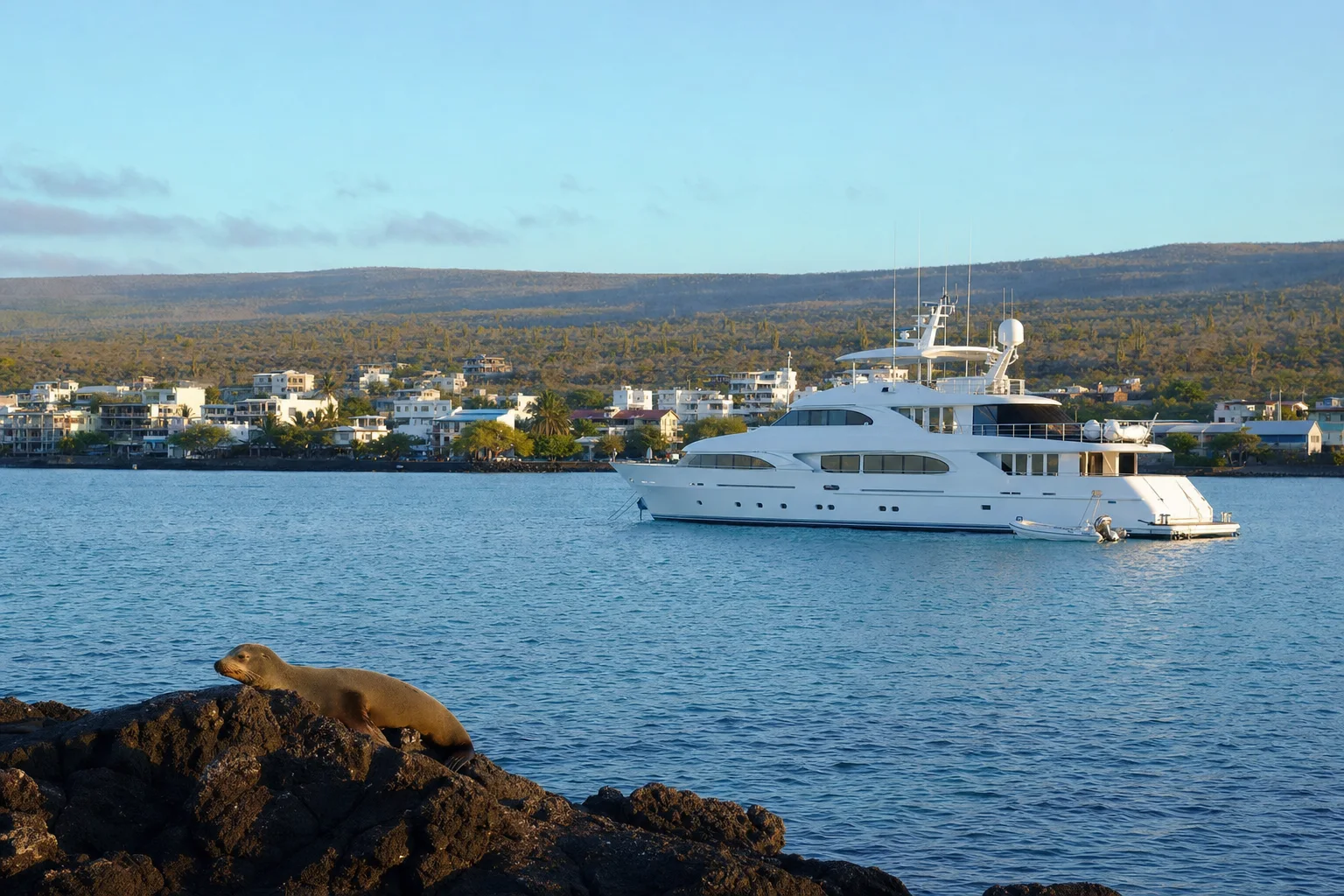
Picture made with AI. It shows the place but is not a photograph.
What the Park checks before a tour
Article 94 of the Galapagos National Park statute (last modified 27 March 2019) lists what the Park inspects on a private foreign or national vessel before it tours the islands.
Check the rules for your passport.
Rules for foreign private vessels
Banned activities
Under article 95 of the statute (last modified 27 March 2019), foreign private non-commercial vessels may not dive, sport fish, or use helicopters or submarines in the protected areas.
Persons list
Article 73 of the 2017 regulation says the people who visit sites must be only those who entered Galapagos on that vessel. The applicant shows this with a notarised or apostilled copy of the zarpe from the port of origin. Check the rules for your passport.
Arrival checks and landing
Arrival inspection
The ABG procedure P06 (version 2.1, November 2019) says boats from abroad, their crew and baggage are inspected on arrival, with a representative of the maritime authority. Organic rubbish is sealed in two bags and taken to the incinerator in the inspector's presence. The captain or the vessel's representative pays the incineration cost.
Landing
The 2017 regulation (article 72) says passengers and crew of non-commercial vessels that arrive at an authorised port may land and buy goods and services from local providers after they pay the Transit Control Card and the conservation fee.
Sources. Checked 8 November 2026.
- Galapagos National Park: Other ways to reach the archipelago
- Galapagos National Park: Information for arrival in the islands
- Galapagos National Park: Entry tribute
- Galapagos National Park: Administrative statute (last modified 27 March 2019)
- Government Council of the Galapagos: Entry fee to the National Park
- Government Council of the Galapagos: Resolution 034-CGREG-20-11-2023
- Government Council of the Galapagos: Digital Transit Control Card, 17 November 2023
- Regulation to the Galapagos Special Regime Law, Decree 1363 (21 April 2017)
- ABG: Procedure P06, inspection of boats from abroad (November 2019)
- WMO World Weather Information Service: San Cristobal-Galapagos
- UKSA superyacht salary guide
- Noonsite: Galapagos, the islands, fees and general info (25 October 2013)
Let the yachts come to you
Upload your CV and we build your crew profile from it. Captains and recruiters contact you. Free for crew.