Superyacht Interior Jobs 2026: From Stew to Chief Stew
What superyacht interior crew do, the certificates you need in 2026, pay by rank and yacht size, and how to climb from junior stew to chief stew or purser.
If the deck crew make a superyacht move, the interior crew make it feel worth being on. That is not a throwaway line. On a charter yacht, the interior department is usually the team guests remember most, the team that drives the reviews brokers read, and the team whose work turns into the tip envelope at the end of the week. Yet it is also the department that outsiders understand least, thanks largely to reality TV.
So for the next instalment in our "what each role does" series, after the deck department guide, I want to walk through the interior properly: who does what, what the paperwork actually requires in 2026, what the pay looks like by rank and yacht size, and how I would plan the climb from junior stew to chief stew or purser.
What the interior department actually does
Think of the interior as a five-star hotel, a private household and a high-end restaurant rolled into one, operating in a space that moves. The work splits into three broad streams:
- Service. Breakfast through to late-night drinks, formal dinners, beach picnics, cocktails on the sundeck, and everything in between. On bigger yachts this becomes its own sub-team with a head of service.
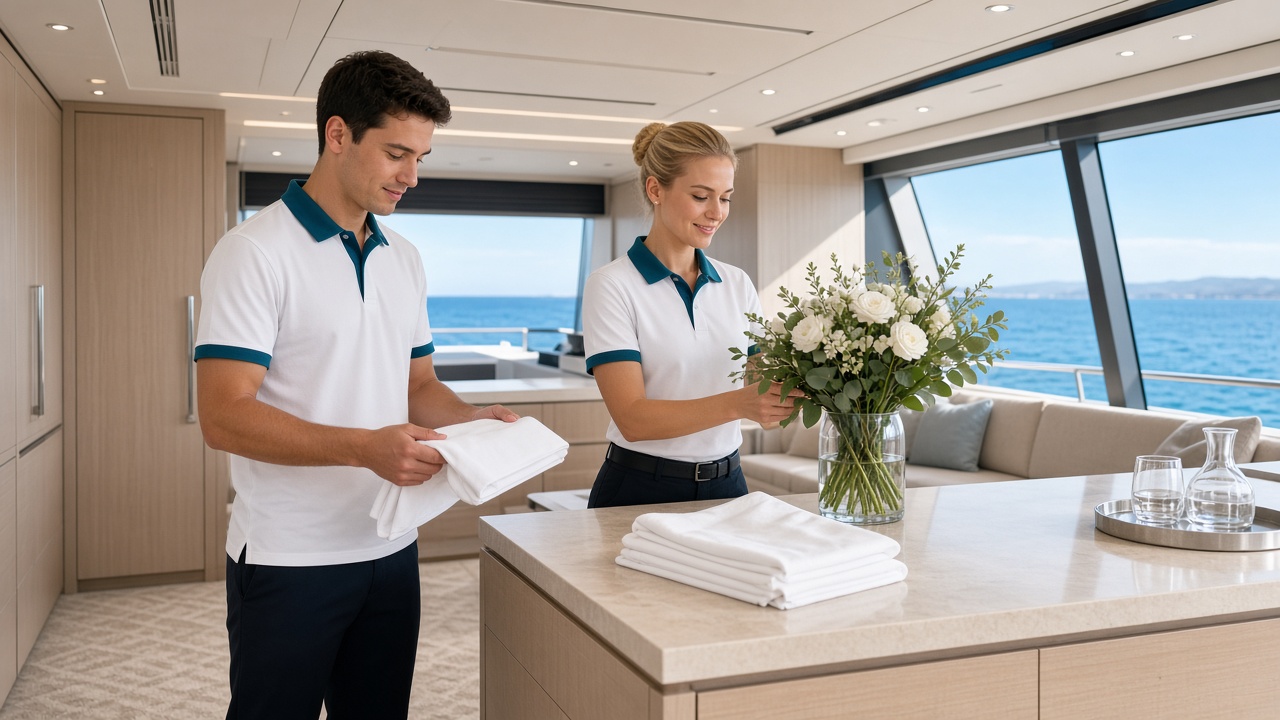
- Housekeeping. Cabins, bathrooms, salons, detailing of high-end finishes that cost a fortune to repair if cleaned with the wrong product. Turn-down service. Floristry. Making a 60m yacht look untouched every morning.
- Laundry. Often underestimated and often the hardest-working corner of the boat. Guest clothing, linens, crew uniforms, delicate fabrics. On a large charter yacht this can be a full-time role on its own.
Behind those three streams sits the less visible management work: provisioning, inventory, budgets, guest preference sheets, and coordination with the galley, the deck team and shore-side suppliers.
The ladder is straightforward on paper. According to the Superyacht Partners glossary, the standard path runs junior or third stewardess, second stewardess, chief stewardess, then purser on larger yachts. The same source puts typical interior headcount at two to three on a 40m motor yacht, four to five on a 60m, and six to ten on an 80m-plus flagship, with dedicated heads of service, housekeeping and laundry at the top end.
That headcount point matters more than people realise. On a small yacht, a stew does everything. On a large one, you specialise. Both are good experience, but they build very different CVs.
The roles, one by one
Junior or third stewardess
This is the entry point. Expect laundry, housekeeping, crew mess duties and supporting service. Long days in season are normal. The single biggest thing captains and chief stews look for here is attitude: reliability, attention to detail, and the ability to stay pleasant at hour fourteen.
YPI Crew makes a sharp point in its 2026 interior salary guide: candidates with genuine hospitality or cruise ship backgrounds adapt faster, understand service expectations from day one and show significantly higher retention. If you are coming from a hotel, restaurant or cruise line, lead with that. It is your edge.
Second stewardess
The second stew is the chief stew's right hand. More service responsibility, often running the floor during meals, training juniors and stepping up when the chief is off. This is where you learn whether you enjoy managing people, because you start doing it.
Chief stewardess
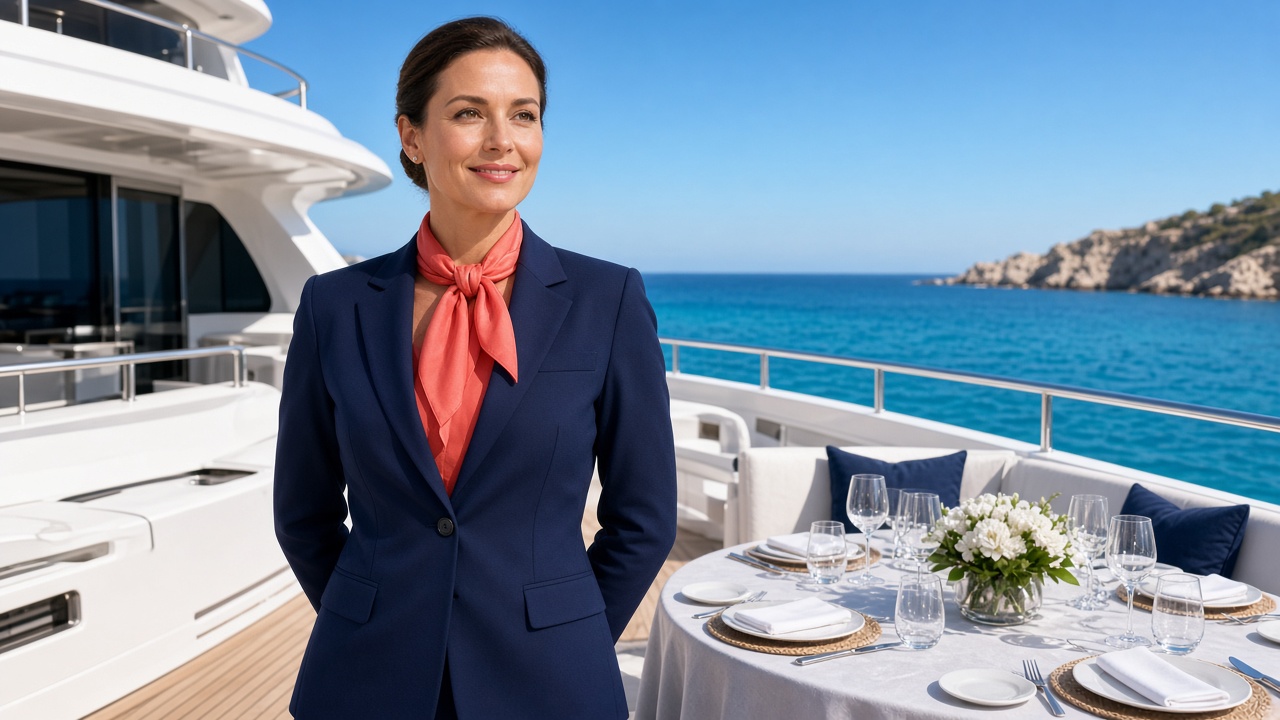
The head of the interior department, reporting directly to the captain and sitting at the senior table alongside the chief officer and chief engineer. The chief stew owns the guest experience end to end, plus the team, the budget and the standards.
Flying Fish's guide to the role is refreshingly blunt: a minimum of five years in the industry is realistic, including at least three years at second stew level, and "you cannot qualify your way into this role." I agree completely. Certificates help, but this job is earned through seasons.
Purser
On 50m-plus yachts, a purser often sits between the chief stew and the captain on admin and accounting. Superyacht Partners notes this split explicitly. Think budgets, crew admin, guest logistics, and sometimes owner-office liaison. It is a natural next step for chief stews who love the organisational side, and for people from hotel management or corporate backgrounds.
Specialist roles
Larger yachts increasingly hire specialists: head of service, head of housekeeping, laundry specialists, and wellness roles such as massage therapists or beauticians who double as stews. If you have a skill in one of these areas, use it. It will get you noticed on the boats where demand is growing.
What you need on paper in 2026
Here is where a lot of online advice goes wrong, so let me be precise.
The mandatory basics for every crew member are STCW Basic Safety Training and an ENG1 seafarer medical (or an accepted equivalent). The YachtSync interior pathway guide cites the relevant MCA notices: MSN 1865 (M) Amendment 1 for basic training and MSN 1886 (M+F) Amendment 3 for the medical. Without both, no captain can hire you.
On larger vessels you will also need extras. YachtSync notes PDSD (Proficiency in Designated Security Duties) on vessels of 500 GT and over, plus Crowd Management and Crisis Management/Human Behaviour training on passenger yachts carrying more than 12 passengers. SeaPapers flags that crowd management catch specifically for heads of interior.
Food safety is not optional if you touch food. SeaPapers says Level 2 food safety is a legal requirement for any interior crew member who processes food in the galley, not only cooks. For chief stews who own the HACCP plan, the Level 3 Award in Supervising Food Safety is the level to hold.
Then there is GUEST. GUEST (Guidelines for Excellence in Superyacht Training) is a voluntary but widely respected framework, with certificates issued by the PYA on behalf of IAMI. According to YachtSync:
- GUEST I has no sea-service entry requirement.
- GUEST II needs 12 months total yacht service and 60 days guest service.
- GUEST III needs 24 months total yacht service and 120 days guest service.
One trap SeaPapers highlights: finishing a GUEST course only gets you a course attendance certificate. The Certificate of Competency arrives once the awarding body receives your signed training record book. Keep that record book up to date from day one. I have seen good crew lose months because the paperwork lagged behind the experience.
What the interior pays in 2026
Pay depends on yacht size, rotation, flag and whether the programme is private or charter. Treat these as indicative, and always check current offers.
YachtSync blends published 2026 guides into these monthly ranges:
| Role | Indicative monthly pay |
|---|---|
| Junior stewardess | €2,500 to €3,500 |
| Second / service stewardess | €3,000 to €4,500 |
| Chief stewardess | €4,500 to €8,000 |
| Purser | €6,000 to €10,000+ |
YPI Crew's 2026 guide breaks chief stew pay down by yacht size: €4,000 to €6,500 a month on 30 to 40m, €5,500 to €7,500 on 50 to 60m, €7,000 to €8,500 on 60 to 80m, €7,500 to €10,000 on 80 to 100m, and €8,500-plus on 100m-plus yachts, with equal rotation at the top end.
Two more numbers worth knowing from Superyacht Partners: rotational contracts (2:2 or 3:3 months on and off) are standard on 60m-plus yachts and carry a 15 to 25 per cent pay premium, and charter chief stews can add €15,000 to €40,000-plus a year from their share of tips.
On tips, one 2026 change is worth flagging. MYBA's updated Guidelines for Charter Yacht Captains and Crew removed the old percentage guidance on gratuities and now stress they are entirely at the charterer's discretion and must never be requested or solicited. Tips still matter, but they should never be part of how you plan your income. Base salary and rotation are what you negotiate.
How I would plan the climb
Here is my practical, slightly opinionated playbook.
1. Pick your first boat for learning, not just salary. A well-run 50m-plus yacht with a strong chief stew will teach you more in one season than a chaotic smaller boat paying a few hundred euros more. Ask in interviews who will be training you.
2. Start your training record book immediately. Your GUEST progression depends on documented sea time and guest days. Do not leave it until you are applying for second stew roles.
3. Build one specialism. Wine, cocktails and barista skills, floristry, laundry and fabric care, or wellness. A specialism gets you onto bigger boats and makes your CV stand out in a pile of near-identical ones.
4. Learn the tech. Modern interiors run on guest preference apps, inventory software and integrated AV and lighting systems. A stew who can troubleshoot the salon screen or manage an inventory spreadsheet properly saves the boat time and money. That is a quiet but real competitive edge in 2026.
5. Say yes to leadership before the title. Train the new junior. Run the laundry rota. Take charge of the provisioning list. Chief stews are hired on evidence that you can already lead.
6. Think about rotation early. If long-term life balance matters to you, target 60m-plus yachts where rotation is standard. The pay premium is a bonus. The sustainability of the career is the real prize.
My take
The interior is one of the best-value career paths in yachting. Entry barriers are low, the skills transfer brilliantly to luxury hospitality and private household management ashore, and the top of the ladder pays genuinely well, especially on rotation. The catch is that progress is earned, not bought. Certificates open doors, but seasons, references and a reputation for calm competence are what move you up.
If you are ready to start or step up, browse the latest superyacht jobs on SuperyachtRoles.com and filter for interior roles. And if you want the bigger picture on pay across every department, our 2026 crew salaries guide is a good companion read.
Sources: Superyacht Partners; YachtSync; YPI Crew 2026 interior salary guide; Flying Fish; SeaPapers; MYBA 2026 captain and crew guidelines update.