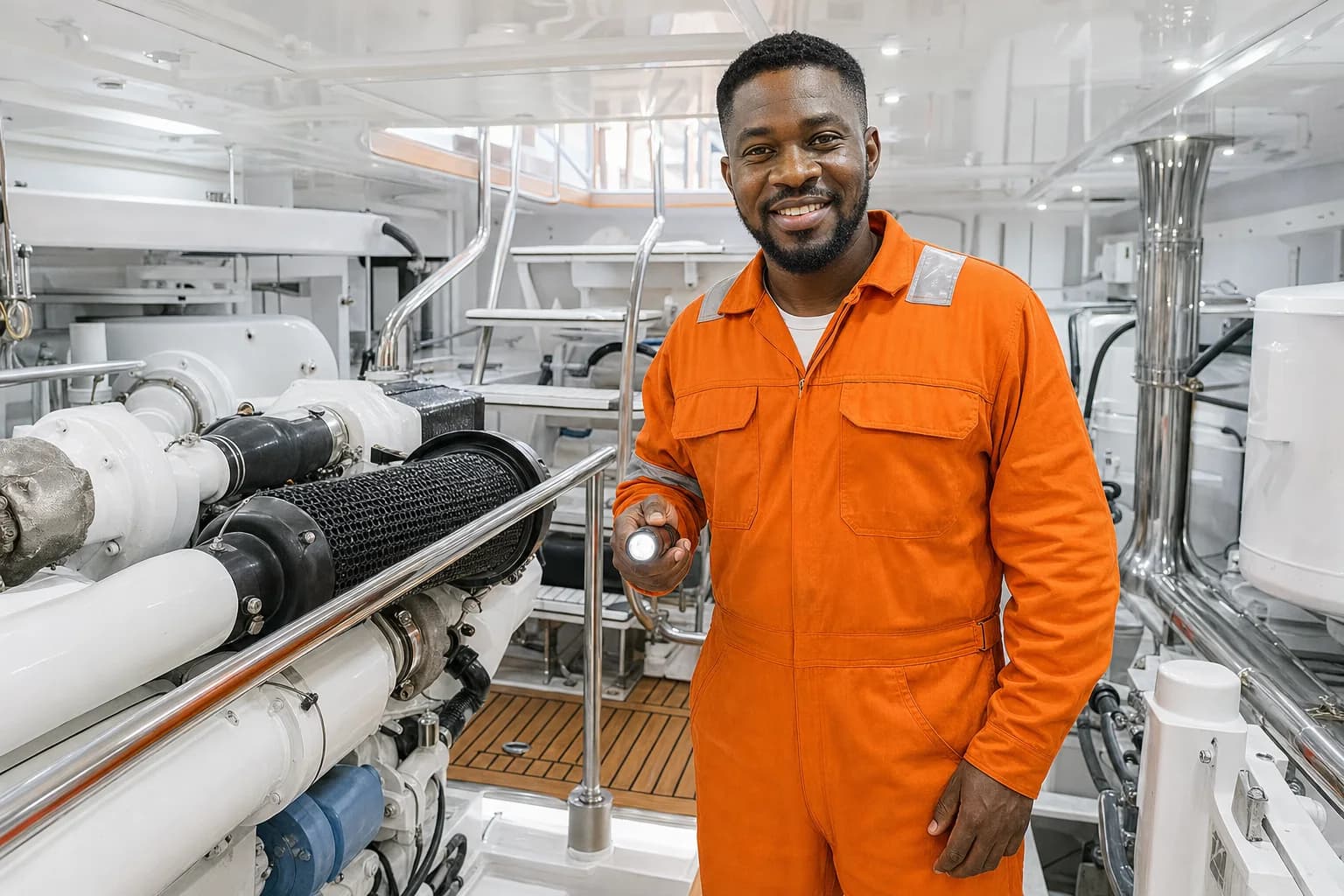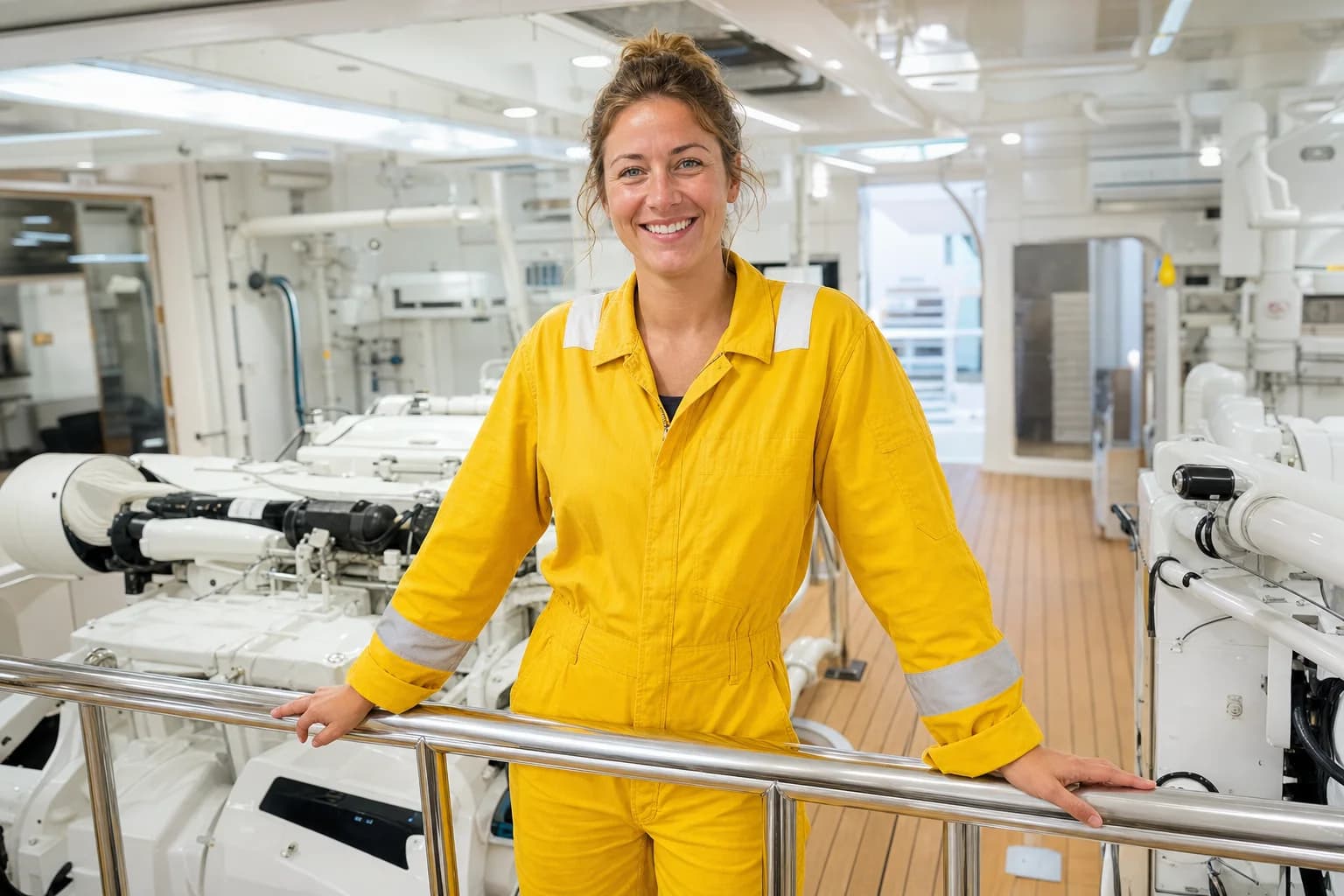
Where the second engineer sits
Wilson Halligan, the recruiter, describes the second engineer as the usual understudy to the chief. The chief commands all engineering work, advises the captain and answers for compliance and surveys. The second carries most of the hands-on load in the engine room. On the largest yachts there is also a first engineer between the two, who allocates daily work so the chief can deal with paperwork. Below the second there may be a third engineer, a fourth, a motorman and, on some very large yachts, a wiper or oiler.
In practice the second is the chief's right hand. You take the jobs the chief does not have time for, keep the juniors working safely and productively, and you need to know the plant well enough to run it for a day or two if the chief steps off. Wilson Halligan notes that on some yachts the second is expected to deputise for the chief.
A working day in the engine room
The day starts with machinery rounds: generators, main engines if running, fuel and water systems, air conditioning plant, sewage treatment and the switchboard. You note readings, check for leaks and odd noises, and pass anything unusual to the chief. Then the day's planned maintenance is shared out between you and the juniors. Wilson Halligan says the second often holds responsibility for engine room maintenance and takes on the more difficult repair jobs.
On passage you either keep a watch or carry unmanned machinery space duties, answering alarms at night. The MCA counts exactly this work, watchkeeping or UMS duties, as qualifying sea time for engineer tickets, which tells you how central it is. In port and at anchor with guests on board, hotel systems become the priority. A failed air conditioning unit or a blocked toilet in a guest cabin needs fixing quickly and quietly.
Planned maintenance and the paperwork
Most yachts run a planned maintenance system. This is software that lists every maintenance task by running hours or calendar date, holds the history for each item of machinery and tracks spare parts. The second often keeps it in order day to day: closing out jobs as they are done, recording what was found, and raising defects and parts orders for the chief to approve. A tidy maintenance history matters at survey time and when the yacht changes hands.
Expect to spend real time at a desk. Running-hour logs, oil and fuel records, bunkering paperwork and permit-to-work forms for hot work or confined spaces often fall to the second on a yacht without a first engineer. Ahead of a yard period you will help the chief write the work list, and during the refit you watch the contractors on the jobs that are yours.
Tickets for the seat and the next step
The MCA now certifies yacht engineers under its Small Vessel scheme, set out in MSN 1904. The operational ticket is Engineer Officer of the Watch, valid on yachts under 9,000 kW and under 3000 GT in any sea area. Under the standard route you need AEC I and II and 12 months of combined sea service and workshop training, with 6 months on watch or UMS duties on vessels of at least 350 kW. You also need the Small Vessel Training Record Book, the Diploma in Maritime Studies or an approved equivalent, written exams, an ENG1 and an MCA oral. You must be at least 18.
Experienced engine room crew can take another route without the diploma. You need 24 months on board, including 6 months seagoing in the engineering department on vessels of at least 200 kW, plus AEC I and II and basic STCW safety training before you register with a training provider. The old Y-series yacht engineer route closed to new notices of eligibility on 31 December 2022. Existing yacht tickets can still be revalidated, or converted to Small Vessel tickets.
Pay
USD a month. Figures are from the Northrop & Johnson 2026 salary guide. Neither it nor YPI Crew 2026 gives a figure below 40m. YPI Crew 2026 prints the same ranges in euros, with the job non-rotational at 40–50m and on equal rotation from 50m. Yacht size and experience move the figure. Refer to the second engineer pay page for pay by yacht size.
What you need
- Engineer ticketThe MCA Small Vessel EOOW (under 9,000 kW, under 3000 GT, unlimited area) is the operational-level engineer ticket. Holders of an older yacht engineer ticket can revalidate it or convert it.
- AEC I and IIBoth Approved Engine Course certificates are required on the standard and experienced seafarer routes to EOOW.
- Sea serviceThe standard route needs 12 months of combined sea service and workshop training, including 6 months on watch or UMS duties on vessels of at least 350 kW. Time spent only cleaning the engine room does not count.
- MedicalA valid ENG1 medical fitness certificate or an accepted equivalent. The MCA advises a medical and sight test, including colour vision, before you start training.
- STCW basic trainingPersonal survival techniques, fire prevention and fire fighting, elementary first aid, and personal safety and social responsibilities. You also need security awareness training.
- Oral examAn MCA oral exam for the ticket. Apart from General Engineering Science I and II, the written exams and the oral must all be passed within 3 years before the ticket is issued.
How to get there
- Years 1-2Engine room crew with AECGain sea time as a motorman, junior or third engineer while holding AEC I and II. For the experienced seafarer route you need 24 months on board, with 6 months seagoing in the engine department on vessels of 200 kW or more.
- Years 2-3Register and complete the record bookRegister with an MCA-approved Small Vessel training provider. Complete the Training Record Book and a further 11 months at sea on vessels of 350 kW or more, including 6 months on watch or UMS duties, plus workshop skills training.
- Year 3 onwardSV EOOW and second engineerPass the exams and the MCA oral for EOOW under 9,000 kW and under 3000 GT. Wilson Halligan says EOOW holders are qualified for junior engineering officer roles, often starting as 3rd Engineer. With more experience they can move up to second engineer.
- After 6 months as EOOWSV Chief Engineer under 3000 kW, under 500 GTYou need 6 months of seagoing service as an EOOW on vessels of at least 350 kW. Then pass the Chief Engineer Statutory and Operational Requirements and Auxiliary Equipment Part II modules and the oral.
- After 12 months as EOOWSV Chief Engineer under 9,000 kW, under 3000 GTYou need 12 months as an EOOW, with 6 months on vessels of at least 750 kW. Add Applied Marine Engineering and General Engineering Science I and II, then pass the oral.
Open now on SuperyachtRoles.com
See all →
Related pages
Questions people ask
Is a second engineer the same as a first engineer?
No. The first engineer exists only on some of the very largest yachts and runs the engineering team day to day, so the chief can focus on administration. On most yachts the second is the chief's direct deputy.
What ticket do I need to work as a second engineer?
Under the MCA scheme the operational-level engineer ticket is the Small Vessel Engineer Officer of the Watch, valid on yachts under 9,000 kW and under 3000 GT in any sea area. The ticket a second engineer needs depends on the yacht's power and tonnage. Wilson Halligan says EOOW holders often start as 3rd Engineer and can move up to second with more experience.
Can I still sit the old Y4 to Y1 yacht engineer tickets?
No. The MCA stopped issuing notices of eligibility for yacht engineer oral exams after 31 December 2022. If you already hold a yacht engineer ticket, you can still revalidate it or convert it to a Small Vessel ticket.
Does a second engineer keep watches?
Usually yes. On passage the second keeps a watch or covers unmanned machinery space duties, answering alarms. The MCA counts watchkeeping and UMS duties as qualifying sea time for engineer tickets.
How much does a second engineer earn?
Northrop & Johnson's 2026 guide gives US$4,500-5,000 a month on 40–50m yachts and US$7,500-9,000 a month on 80–100m yachts. The 100m+ band is lower, at US$6,500-7,500. The guide does not say why, though it lists a separate 1st Engineer post only at that size.
What is the next step up from second engineer?
For most seconds the next seat is chief engineer. That means a Small Vessel Chief Engineer ticket, which needs 6 or 12 months of sea time as an EOOW depending on the power and tonnage limit, plus extra modules and an oral.
Sources
- GOV.UK (Maritime and Coastguard Agency): MSN 1904 Engineer Officer Small Vessel CoC
- Maritime and Coastguard Agency: MSN 1904 (M+F) full notice, PDF
- Superyacht Content with Wilson Halligan: how superyacht engineering departments are structured
- Wilson Halligan: how to become a yacht engineer, qualifications and requirements