What does the job involve day to day?
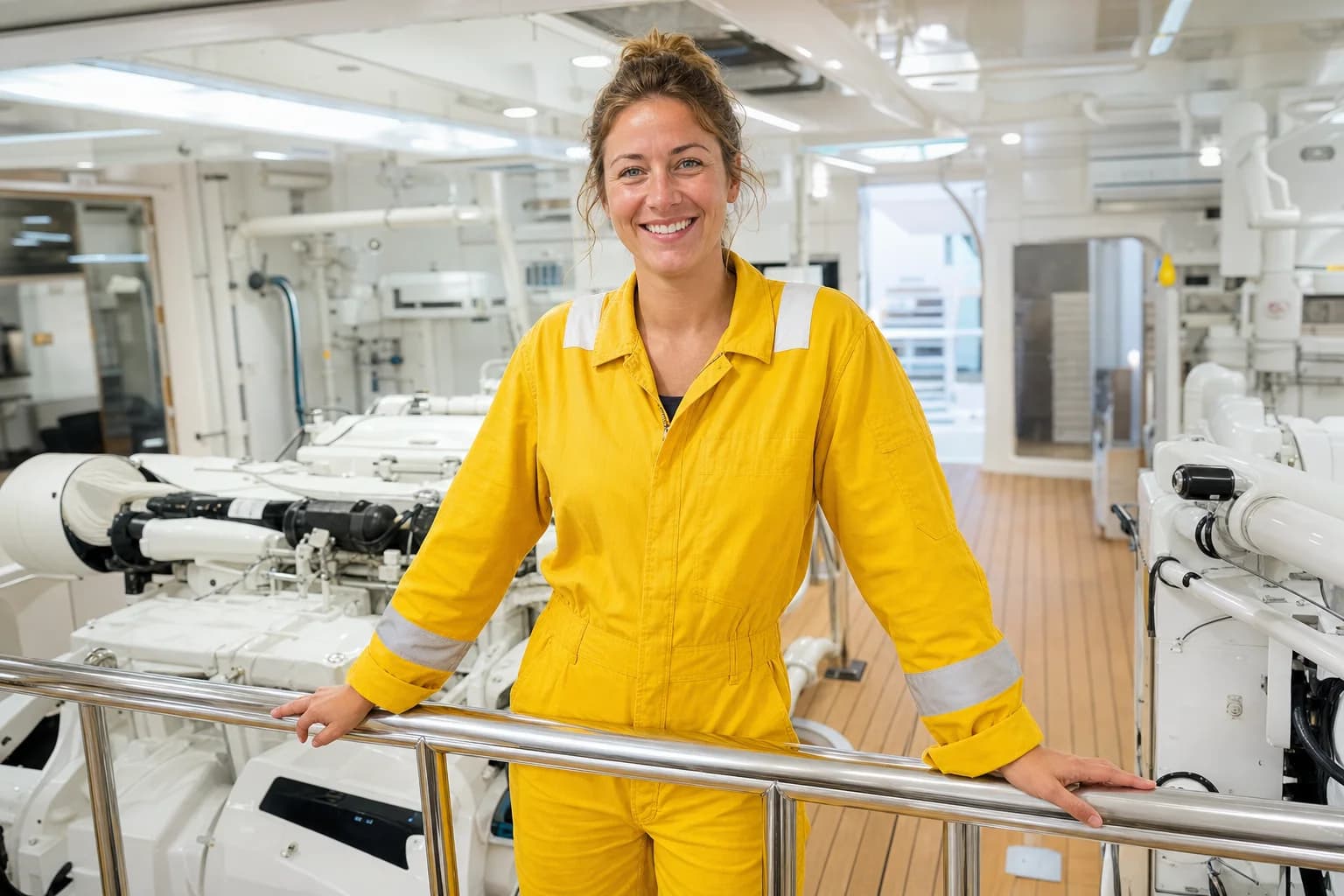
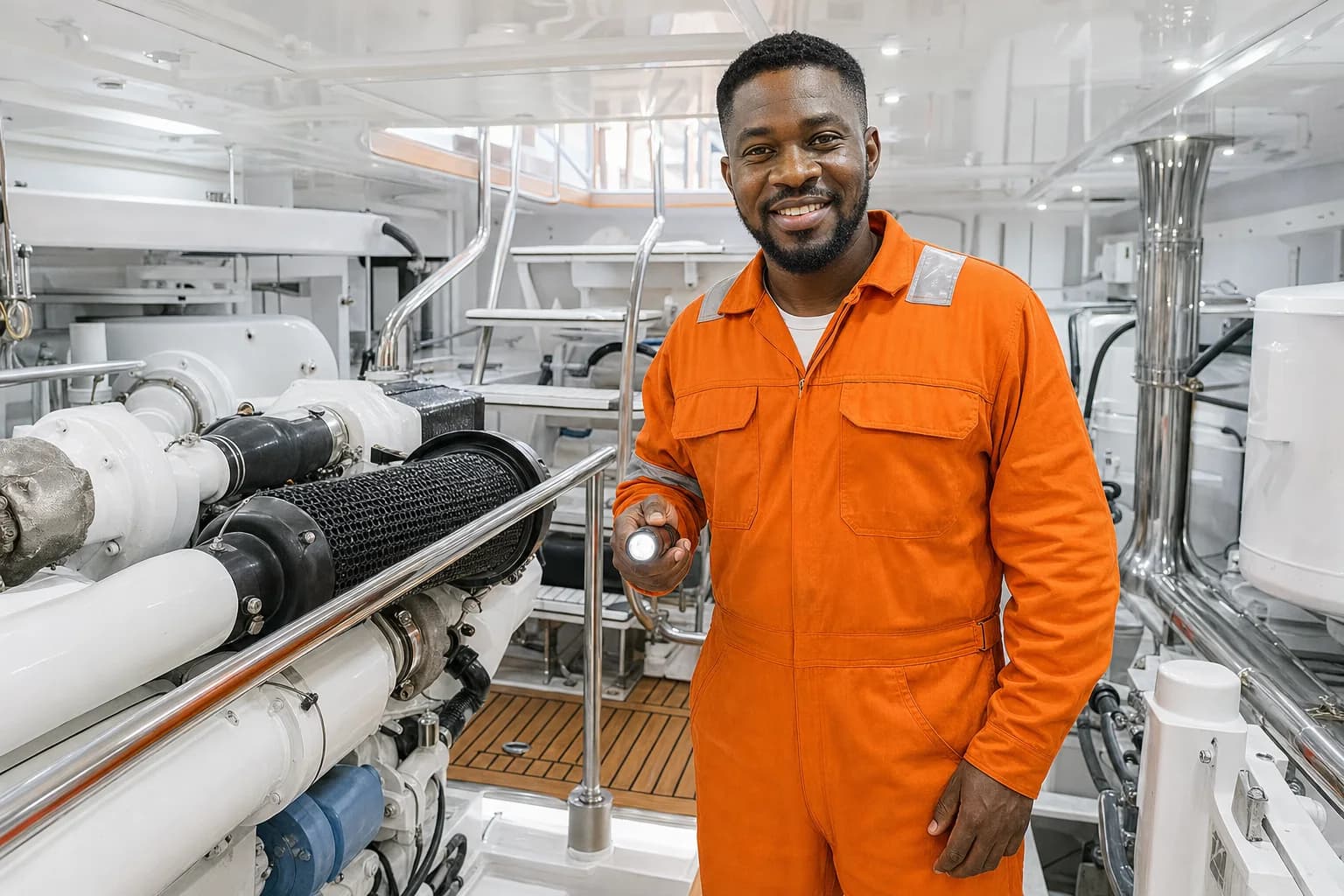
You are the engine department. YaCrew describes the sole engineer as running all engineering duties alone, usually on smaller yachts, and covering propulsion, power and auxiliary systems. UKSA's engineering course page adds the tenders and water toys. In practice that means main engines, generators, air conditioning, watermakers, sewage and fuel systems, and every pump on board. Nobody else will spot a weeping seal or a rising exhaust temperature for you.
The paperwork is yours as well. You keep the maintenance records, order spares, deal with contractors in the yard and get the machinery ready for surveys. Onboard Online notes that the size, type and use of the yacht shape the job, and that a sole engineer covers operation and maintenance across the board. On a busy charter yacht your planned maintenance has to fit around guests. On a private yacht with long periods at anchor it fits around the owner's movements.
Which ticket do you need for which yacht?
The MCA's yacht manning guidance, written with the other Red Ensign Group flags, sets the lowest ticket the chief engineer must hold. The figures depend on tonnage, propulsion power and distance from a safe haven. Within 60 miles, a yacht under 200 GT and 1,500 kW needs an AEC 1. Up to 3,000 kW it needs AEC 1 and 2 or a MEOL. A yacht under 500 GT and 3,000 kW needs the Small Vessel Chief Engineer under 500 GT, under 3,000 kW (STCW III/3). That same ticket covers any of those yachts on unlimited voyages. The tables are guidance, and each flag sets its own manning.
The old Y tickets have closed. The MCA stopped issuing new Notices of Eligibility for the yacht structure on 31 December 2022. It still revalidates existing yacht tickets. If you hold one, you convert and move up through MSN 1904. GOV.UK lists Y4 as Chief Engineer under 200 GT and 1,500 kW, and Y3 as under 500 GT and 3,000 kW. Y4 holders can ask for an endorsement up to 500 GT and 3,000 kW within 60 miles after 6 months' service as an officer.
How is it different from a second engineer on a bigger yacht?
A second engineer works under a chief, often on rotation, and has someone to check their judgement at three in the morning. The sole engineer makes that call alone and then explains it to the captain. In the MCA tables, the larger bands start listing more engineers: an assistant engineer, an Engineer Officer of the Watch, or a second engineer once the yacht reaches 500 to 3,000 GT on unlimited voyages. The guidance says most yachts can carry an Engineer Officer of the Watch in place of a second engineer.
There is no YPI or Northrop & Johnson line for a sole engineer. The nearest is the chief engineer line, because you hold that rank by default. YPI Crew's 2026 guide gives €5,000 to €7,000 a month for chief engineers on 30–40m yachts, non-rotational, where it expects an AEC or EOOW ticket. At 40–50m it gives €6,500 to €8,000 and expects Y3.
Will you work on deck too?
On small yachts, usually yes. The MCA manning guidance allows a dual-purpose deck and engineering post, held by anyone other than the master. The yacht needs either a UMS notation from its classification society, or three things: full bridge control of the main engines, high-level bilge alarms in the machinery space, and engine room alarms relayed to the accommodation or bridge. MSN 1904 also recognises sea time as a dual-purpose deckhand and engineer for the MEOL licence. Expect to help with lines, tender runs and washdowns when the engine room is quiet.
Pay
USD a month. Northrop & Johnson 2026, Chief Engineer line, used because no guide prints a sole engineer figure; neither guide prints a figure under 30m. YPI Crew 2026 euro figures appear in the text only. Yacht size and experience move the figure. Refer to the Engineer salary guide for pay by yacht size.
What you need
- ENG1 medicalMSN 1904 requires a valid ENG1 or accepted equivalent before your first trip to sea and for every engineering ticket.
- Basic STCW safetyPersonal Survival Techniques, Fire Prevention and Fire Fighting, Elementary First Aid, and Personal Safety and Social Responsibilities, as listed in MSN 1904.
- AEC 1 and 2The Approved Engine Course is the entry engineering certificate. Under the manning guidance, AEC 1 alone covers the chief's post only on the smallest, short-range yachts.
- MEOL (SV)A non-STCW licence for vessels of 200 to 750 kW where STCW does not apply. You must be at least 19, with 24 to 36 months' onboard service depending on the role you served in.
- SV Chief Engineer <500 GT, <3,000 kWNeeds 6 months' seagoing service as an SV Engineer Officer of the Watch on vessels of at least 350 kW, two MCA exams and an oral exam.
- Verified sea timeThe MCA wants yacht sea time verified by Nautilus International or the PYA. Without it, applications can be delayed by around 160 days.
How to get there
- Before joiningBasic ticketsENG1, basic STCW safety courses and AEC 1 and 2.
- First 2 yearsBuild engine room timeThe experienced seafarer route needs 24 months onboard, including 6 months at sea in the engine department on vessels of at least 200 kW.
- After registrationSV Engineer Officer of the WatchRegister with an MCA-approved training provider, complete the training record book, pass the exams and the oral.
- After 6 months as EOOWSV Chief Engineer <500 GTServe 6 months at sea as an EOOW on vessels of at least 350 kW, then pass the chief's modules and oral. This is the usual ticket for a sole engineer post.
Open now on SuperyachtRoles.com


Related pages
Questions people ask
Can I be a sole engineer with only an AEC?
On a UK-flagged yacht under 200 GT and 1,500 kW working within 60 miles of a safe haven, the MCA manning guidance lists AEC 1 for the chief engineer. Beyond those limits you need a MEOL or a Small Vessel Chief Engineer ticket. Other flags may set different levels.
Is my Y4 or Y3 still valid?
Yes. The MCA still revalidates yacht tickets, but it stopped issuing new Notices of Eligibility on 31 December 2022. To progress, you convert to a Small Vessel ticket under section 7 of MIN 642 and then move up through MSN 1904.
What ticket covers most sole engineer jobs?
The Small Vessel Chief Engineer under 500 GT, under 3,000 kW (STCW III/3) covers the chief's post on yachts in that band, including on unlimited voyages. Yachts under 500 GT with up to 6,000 kW need an extra near-coastal endorsement or a higher ticket.
Do sole engineers rotate?
Often they do not. YPI Crew lists chief engineers on 30–40m yachts as non-rotational, and on 40–50m yachts as non-rotational or equal rotation.
How much does a sole engineer earn?
Neither salary guide has a sole engineer line. Northrop & Johnson's 2026 chief engineer line gives US$6,000 to $8,000 a month on 30–40m yachts and $7,000 to $10,000 on 40–50m yachts.
Sources
- GOV.UK (MCA): Engineering Officers and Ratings
- GOV.UK (MCA): Certification for Engineer Yachts
- MCA: Large Yacht Manning Levels guidance
- MCA: MSN 1904 (M+F) Engineer Officer Small Vessel CoC
- YaCrew: Sole Engineer jobs
- Onboard Online: guide to superyacht engineering careers
- Superyacht Content: how engineering departments are structured
- UKSA: MCA Approved Engineering Course